
Project Overview
#BeReadyForTicks: A Digital Media Tick-bite Prevention Education Campaign With Just-in-Time Learning Tools
Commodities
- Community and Urban Pest Management: institution/shelters/municipal buildings/public places, public health
- Human Health: workers, residents, applicators
- Natural Areas: other
Target Pests
- Target Pests: ticks
Practices
- Pest Management: behavioral control, disease vectors, prevention
- Natural Resources/Environment: other
- Sustainable Communities: public participation
Proposal abstract:
Most learning opportunities about tick-bite prevention are delivered using Just-in-Case learning approaches–knowledge/tips taught by lecture, webinar, pamphlet, or media report–usually in settings where ticks are not present, tick encounter risk is not eminent, and at times when ticks may not be forefront in participants’ minds. Later, when people are about to enter tick habitat or have a tick encounter, it can be difficult to accurately recall Just-in-Case-learned information. According to psychologist Hermann Ebbinghaus, discoverer of the “Forgetting Curve”, if new information isn’t applied, people forget about 75% of it after just six days. But details matter when it comes to tick bite prevention! To make tick prevention education more memorable and effective, the #BeReadyForTicks (BRFT) campaign seeks to flip tick bite prevention education from a Just-In-Case pedagogy to using Just-in-Time learning tools--providing easy access to practical, “actionable” information and resources when the information is most relevant and applicable--when it can be practiced right away to help prevent tick-bites.
The showcase of BRFT is an innovative, QR-coded Warning-Tick Habitat sign prompting anytime access to practical and prioritized tick prevention education resources, tailored to the most-likely tick encounter risk. Imagine, outdoor adventurers standing at the trailhead use their smartphones to scan the QR-code, leading them Just-in-Time to best practices in tick bite protection that can help them most in the moment—what they need to know about tickborne disease prevention, at the moment they need to know it–whether before starting down the trail, upon returning home, if they just found a tick, or before heading out on their next outdoor adventure.
In this project, partnering organizations will be provided BRFT signs for posting at high tick-risk properties and will assist researchers in assessing tick-risk awareness and adoption of tick-bite prevention practices by distributing electronic communications and surveys to their user communities.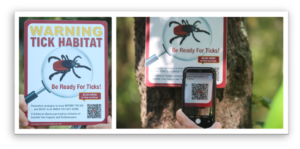
Project objectives from proposal:
Objectives
The goal of this NE IPM communications project is to create a transformative approach to tick bite prevention education – Just-in-Time learning. Ubiquitous smartphones are today’s portal to anytime learning, even when you’re launching off on a hike. Instead of static warnings with largely non-actionable advice, QR-driven Warning, Tick Habitat signs may result in more appropriate tick bite behaviors, fewer tick bites, and less tickborne disease by educating and encouraging people to practice TickSmart™ actions when they are needed most. Specifically, placing signs in locations where people are at high-risk of tick encounters, with its QR-code linked to an easily updated web landing page containing prioritized and readily-actionable tick bite prevention strategies -- Just in Time -- for the moment when you’re standing at the trailhead -- for when you get home from your outdoor adventure -- for if you find a tick attached -- and, for before you go on your next adventure, this collaborative multi-state project will:
- Facilitate and promote interstate collaboration by partnering with at least five regional organizations willing to adopt the #BeReadyForTicks campaign.
- Increase awareness of tick habitats and best-IPM practices for tick bite prevention by posting at least 100 Warning Tick Habitat signs in several states in the Northeast region via our regional partners (mentioned above).
- Develop a Be Ready For Ticks landing page with prioritized, best-IPM practices for tick bite prevention to increase awareness, knowledge, attitudes, skills, aspirations, behaviors, and adoption of best-IPM practices.
- Design several assessment tools to measure changes in awareness, knowledge, attitudes, skills, aspirations, behaviors, and adoption of best-IPM practices for tick bite prevention.
- Conduct assessments to document changes in awareness, knowledge, attitudes, skills, aspirations, behaviors, and adoption of best-IPM practices for tick bite prevention.

